Analysis of Tower Rush
Reviewing a crash game is a different exercise from reviewing a slot. Slots are evaluated based on graphics, paylines, and bonus spins. Crash games are assessed on the tension they generate, the decisions they require, and the balance between risk and reward.
Tower Rush by Galaxsys lends itself well to an in-depth review because it offers material to think about. It’s not a passive game where you press a button and wait. Every round asks the player to do something, to choose, to take risks. This constant activity creates an experience that deserves careful analysis.
Here is our complete review, built after weeks of testing in demo mode and with real money.
First impression and learning curve
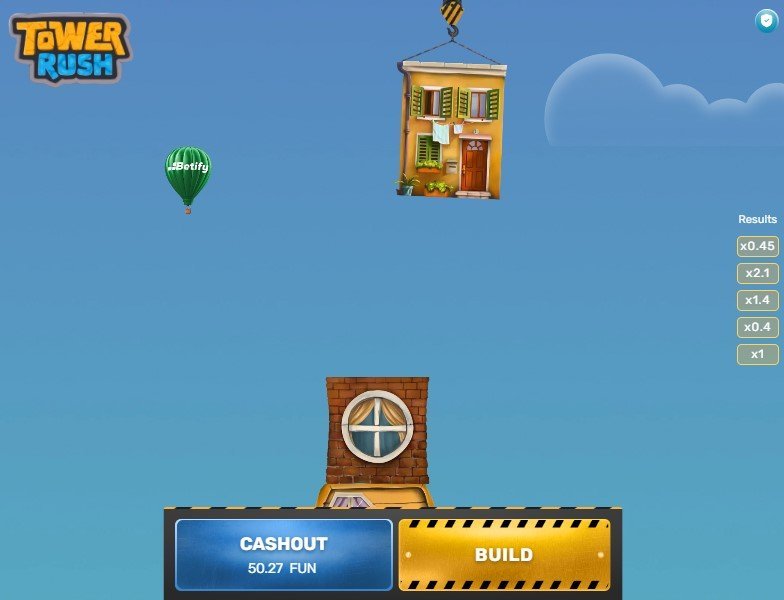
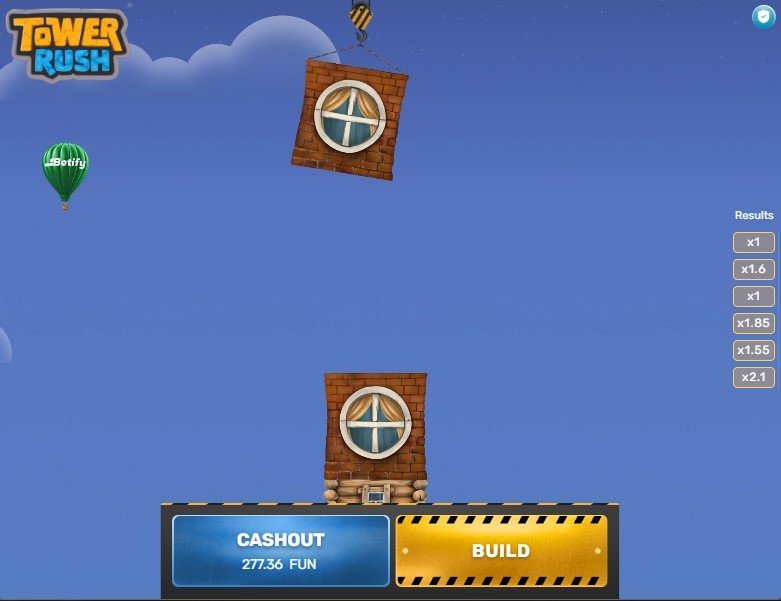
The first impact with Tower Rush is positive. The interface is clean, the controls are intuitive, and the concept is understood in a few seconds. A block swings, you click, the block is positioned. If it goes well, the tower grows. If it goes poorly, it collapses.
The real surprise comes after five or six rounds. The early rounds are so easy that they give a false sense of mastery. Then the pace changes. The block accelerates, the tolerance decreases, and the player realizes that Tower Rush requires much more than the apparent simplicity suggests.
The learning curve has a particular shape: flat for the first rounds, steep between the fifth and fifteenth, then stabilizes as the player internalizes the movement patterns. After about 50-60 rounds (in demo or paid), most players find their rhythm and comfort level.
This progression gives Tower Rush a sense of personal evolution that is lacking in almost all traditional slots and crash games. You improve. You feel the difference. And it’s rewarding.
Analysis of game mechanics
The heart of Tower Rush is the simultaneous management of two tensions: the precision of placement and the temptation of the increasing multiplier.
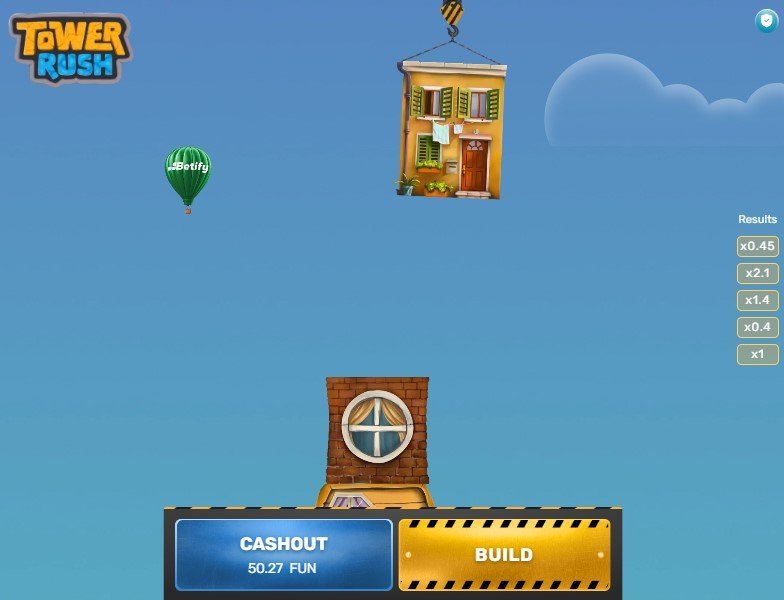
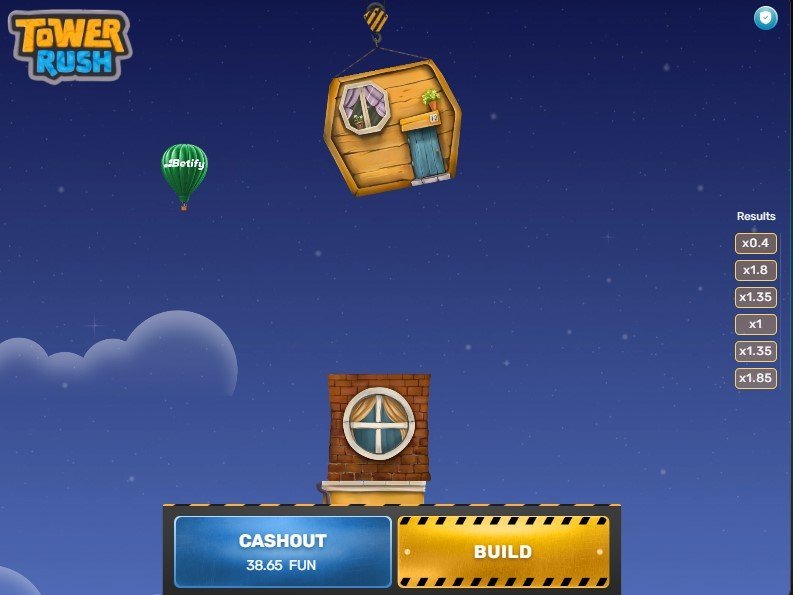
Each round features a crane with a swinging block. The movement is lateral, above the tower under construction. The speed and amplitude change with height. The early rounds are generous. After the fifth, each additional level demands more attention.
What makes the mechanics interesting is the non-linearity. You don’t transition from "easy" to "hard" with a sharp step. The transition is smooth, almost imperceptible round after round. A focused player may not realize that the difficulty has increased until a placement fails.
Manual cashout adds a second level of decision-making. The CASHOUT button is always visible, always active. Every completed plan poses the same question: "do I continue or cash out?" This repeated choice at every level creates a cumulative tension that no passive crash game can replicate.
The absence of auto-cashout is a deliberate design choice. Galaxsys could have implemented an automatic system, like Aviator and Spaceman do. Not having done so keeps the player engaged at every moment. It’s a choice that excludes those who want to play casually, but rewards those seeking an immersive experience.
The bonuses: analysis of the real impact
Three bonuses. All random. None can be activated voluntarily. Here’s how they perform in practice.
TheFrozen Flooris the undisputed star. It freezes the multiplier reached as the minimum earning threshold. From that moment on, the round becomes a low-risk opportunity: you can try to climb higher, knowing that the base gain is secure. In our tests, the Frozen Floor turned ordinary rounds into memorable moments. A concrete example: a bet of €1, Frozen Floor at x9, attempt at three additional levels, tower collapsed at the second. Earned payout: €9. Without Frozen Floor, it would have been zero.
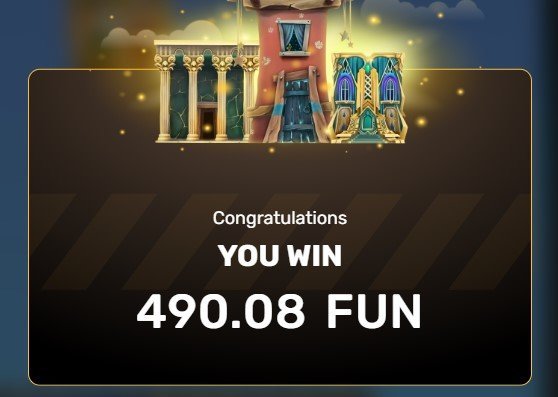
TheTemple Floorproduces more variable results. The bonus wheel assigns multipliers ranging from modest to significant. Out of 15 Temple Floors encountered in our tests, 9 produced an increase of less than x1.5. The remaining 6 offered boosts between x2 and x3. Pleasant as a surprise, less reliable as a strategic tool.
TheTriple Buildis mathematically the most advantageous. Three levels positioned with perfect precision, zero risk of error. The multiplier rises three levels for free. The only decision to make: cash out immediately after the bonus or continue manually. In our tests, cashing out immediately after the Triple Build produced more stable results compared to continuing.
The distribution of bonuses does not follow a predictable pattern. In some sessions, all three appeared within 20 rounds. In others, only one bonus appeared in 35 rounds. Planning the session counting on bonuses is a mistake. Welcoming them when they arrive and reacting rationally is the correct approach.
Frozen Floor
Freezes a level and prevents destruction. A temporary shield to protect winnings.
Temple Floor
Golden level with bonus multiplier. Significantly increases potential winnings.
Triple Build
Places 3 blocks simultaneously for accelerated building and controlled risk.
RTP and volatility: the numbers behind the experience
Tower Rush declares an RTP between 96.12% and 97%. To put it in context: this figure places the game above the average of classic slots and in line with the best available crash games.
But the RTP tells only half the story. The other half is told by volatility.
Tower Rush is rated high volatility. Essentially, this means that session results fluctuate significantly. In 30 rounds at €1, a result between +€18 and -€15 is perfectly normal. In shorter sessions (10-15 rounds), the extremes can be even wider.
The combination of high RTP and high volatility creates a specific profile: over the long term, the game retains less money compared to a slot at 94%. In the short term, the fluctuations can seem dramatic. A player who loses €8 in 10 rounds is not experiencing a flaw in the game. They are experiencing the natural variance of a high volatility title.
For players who prefer stable sessions with frequent small wins, Tower Rush is not the ideal format. For those who accept wide fluctuations in exchange for potentially very rewarding moments, the profile is suitable.
The mobile experience: honest pros and cons
Opinions of Italian players
“Peter, Livorno — March 2026** ⭐⭐⭐⭐ (4/5) Tower Rush has a real learning curve. The first rounds seemed trivial to me. After twenty games, I realized that the higher levels are a different sport. Now my average cashout is x5 and I’m perfectly fine with it.”
“Ariana, Ravenna — February 2026** ⭐⭐⭐⭐⭐ (4.5/5) The Frozen Floor is the reason I keep playing Tower Rush instead of going back to Aviator. Knowing that the gain is protected allows me to take a few more risks without the knot in my stomach.”
"Dan, Taranto — January 2026** ⭐⭐⭐⭐ (4/5) The mobile game has its limits. I tried it both on my phone and on my laptop: the difference at higher levels is evident. But for quick sessions during lunch breaks, the phone does its job."
"Ilaria, Novara — March 2026** ⭐⭐⭐⭐ (4/5) You need to understand the volatility before you start. The first sessions threw me off because I didn’t understand how I could finish five rounds in a row without a win. Then I read about how variance works, and everything made more sense."
"Tom, Treviso — February 2026** ⭐⭐⭐⭐⭐ (5/5) What I like is that every round counts. There’s no autopilot. If you lose focus for a second, the block lands wrong and the tower goes down. It keeps you alert."
Frequently Asked Questions
Yes, as long as you spend time on the demo. The mechanics are intuitive, but the high volatility can surprise those without experience in this format.
Between 15 and 25 minutes for 20-30 rounds. Beyond that, concentration tends to drop, and the quality of placements suffers.
No. Tower Rush requires an active internet connection. The game communicates with the server at every round to ensure the integrity of the RNG.
Yes. The interface adapts to screens of different sizes. On a tablet, the experience is intermediate between smartphone and PC: more space than on the phone, but touchscreen as input.
Galaxsys does not publish an update schedule. Changes, when they occur, generally involve performance optimizations rather than gameplay changes.
Both. Skill in positioning affects survival at higher levels. Luck determines the block's fluctuations, the appearance of bonuses, and overall variance. Neither component completely dominates the other. ---
Final Review — 4.2/5
Tower Rush is a crash game that does things differently from the competition, and that’s enough to make it interesting. The active gameplay, the three well-integrated bonuses, and the permanent manual cashout create an experience that requires mental presence and rewards methodical players.
The Frozen Floor remains the most distinctive element. The Triple Build is the most rewarding. The Temple Floor is the most divisive. Together, they give Tower Rush a depth that other crash games do not offer.
Flaws exist: visual repetitiveness, lack of multiplayer, poor communication from the developer. None compromise the gameplay, but they leave room for future evolutions that could further elevate the product.
For the Italian player in 2026, Tower Rush represents one of the most valid options in the crash game segment. As long as you choose a reliable platform, manage your budget with discipline, and accept that volatility is part of the game.
Rating: 4.2 / 5⭐⭐⭐⭐
The developer under the microscope
Galaxsys is not a studio that presents itself with aggressive marketing campaigns. Its profile is technical: it develops quick games, distributes them through partners, and lets the products speak for themselves.
The portfolio includes several titles in the instant game and crash game segments. Distribution on MGA and Curaçao licensed platforms implies that every game in the catalog undergoes periodic audits. The code is verified, the RNG tested, and compliance with the declared RTP confirmed.
For Tower Rush, Galaxsys has integrated the Provably Fair system on some platforms, an initiative that few studios of the same size propose. The willingness to offer verifiable transparency suggests confidence in their product.
The studio is not perfect. Communication with end players is almost non-existent (no blog, no official community, few dedicated FAQs). Those looking for information on Tower Rush find it on partner casino sites, not from the source. An obvious margin for improvement.
What doesn't work (or could work better)
An honest review does not hide the flaws. Tower Rush has some that are worth mentioning.
Visual repetitiveness.The game's aesthetics are pleasant but static. After 50 rounds, the tower, background, and animations become predictable. A system of visual themes or variable settings would add freshness without changing the mechanics.
The absence of multiplayer modes.No leaderboard, no shared rounds, no player challenge system. Real-time comparison with other builders would add a social dimension that is currently completely lacking.
The developer's communication.Galaxsys leaves it to the casinos to inform players. The result: fragmented information, sometimes contradictory across different platforms. An official portal with FAQs, changelogs, and updated data would improve the experience.
The inability to review past rounds.A replay of previous rounds, with the ability to analyze placements, would be a valuable learning tool. Currently, once the round is over, there is no visual trace of the action.
None of these points undermine the overall experience. But they indicate areas for improvement that could elevate Tower Rush from a "good crash game" to a "benchmark in the segment."
Note on responsibility
Tower Rush is an entertainment product based on gambling. The casino maintains a structural mathematical advantage. High volatility amplifies balance fluctuations. These are facts, not opinions.
Playing responsibly means:
- Allocating only amounts for gaming that do not affect necessary expenses
- Setting time and money limits before each session
- Using the self-limitation tools offered by regulated platforms
- Stopping when the game generates frustration instead of enjoyment
The Gambling Helpline (800 558 822) offers free and anonymous support.